
Buying Okoume Lumber: Grade, Moisture and Thickness Checks
Compare okoume lumber offers with a buyer checklist: contract-defined grade, ordered KD moisture, thickness tolerance, packing, docs and FOB/CFR terms.
Two okoume lumber quotes sit on your desk. Same species, near-identical price per cubic meter, wildly different risk. The gap won't show up in the price line. It shows up in the thickness you actually receive, the grade nobody defined, and the moisture number nobody measured. Here's the checklist we'd give any importer comparing offers — whether they buy from us or not.
Sizes first: thickness, width and length in writing
Most okoume lumber trades on a handful of stock sizes. Ours runs 25 / 38 / 50 / 75 mm (100 mm and other sizes can be arranged by order), with 2.4 m lengths and up as the routine floor — some production lines reach 4.2 to 4.5 m. Width is random, as it is for most West African lumber off the saw; some runs hold 150 mm and above, and ripping to width is possible when your order justifies it.
The trap hides in tolerance. Some lines carry up to +3 mm over the named thickness; others don't, and which behavior applies gets confirmed per order. If your planer can't eat three extra millimeters across a container, ask that question line by line and get the answer in writing before payment. Same logic on the other side: imagine a joinery shop needing four-meter clear blanks — that buyer should ask whether the current run actually delivers them, not assume the species brochure does.
You'll see the same wood sold under two labels. In US-market sourcing people say okoume lumber; in European and African trade the phrase okoume timber is more common. Same tree, Aucoumea klaineana out of Gabon and Congo — but always check which size and grade conventions a seller is quoting against.
FAS is a word until the contract defines the trim
"Grade: FAS" appears on more offers than any other line — and it's the most abused two-letter pair in tropical lumber. The real FAS comes from the NHLA rulebook for North American hardwood, described in plain terms by AHEC (the American Hardwood Export Council): boards yielding 83-1/3% clear cuttings across the whole board, minimum board size 6 inches wide by 8 feet long, with clear-cutting rules that reference widths and lengths in feet. Fine rules. They were written for American oak and maple, not for a mixed run of Congolese okoume.
African origin trades on commercial grades defined between buyer and seller. Which means FAS means nothing unless the contract defines the trim — put it in writing: minimum clear widths and lengths per face, what counts as a defect, what's allowed on the back face, and how moisture gets checked at loading. We work to FAS or contract grades agreed per order, and a spec sheet you can staple to the contract beats an adjective in an email every single time.
AD or KD: order your moisture number, don't hope for it
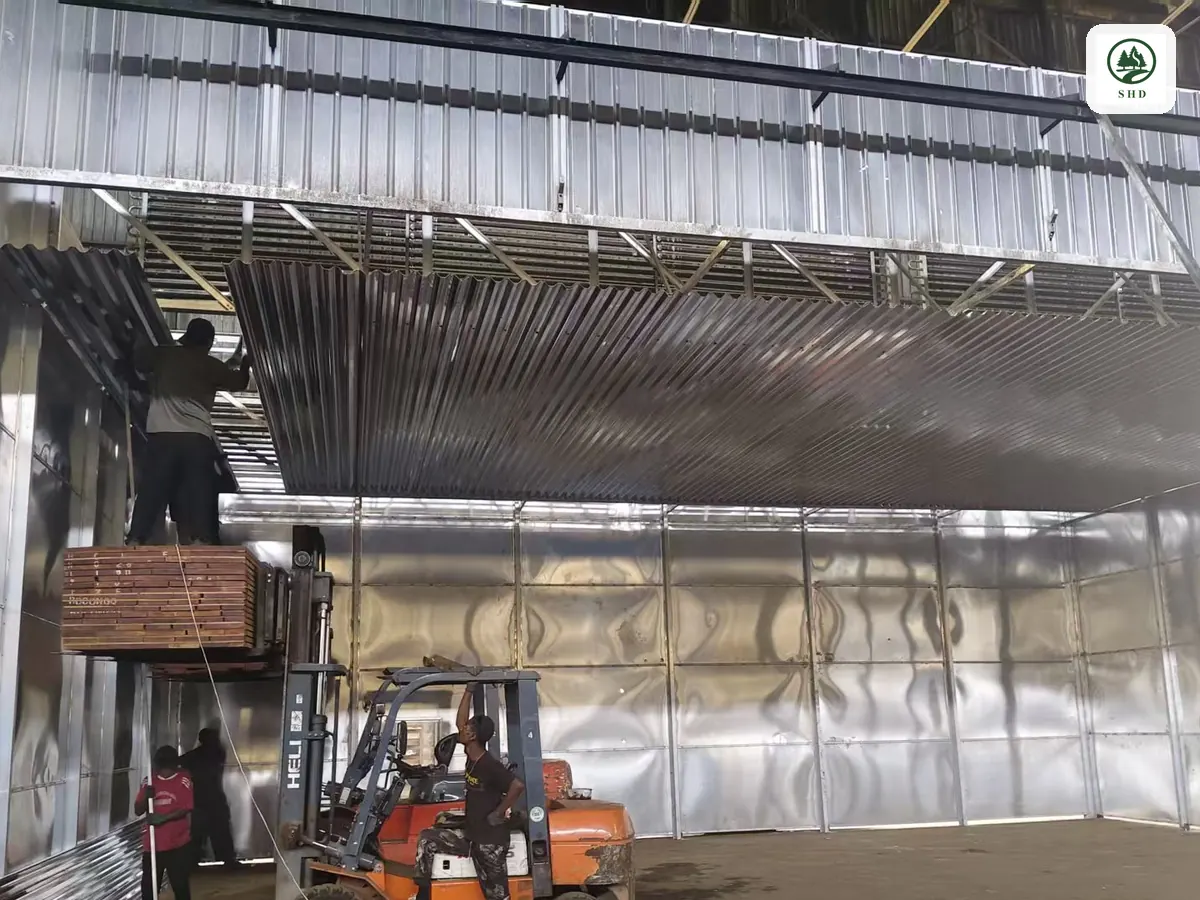
Air-dried stock is cheaper and usually fine for covered yards and further processing. Kiln-dried stock is where deals quietly go sideways, because "kiln dried" is a process, not a number. The USDA Forest Service's Wood Handbook (Chapter 4, moisture relations) explains why that number matters: wood keeps trading moisture with the air around it until it reaches equilibrium with local temperature and humidity. Ship lumber wetter than your destination's equilibrium and it shrinks, checks and cups in your warehouse. Ship it bone-dry into humid coastal air and it swells on you instead.
A kiln schedule isn't one knob. Soak time and final moisture depend on species, thickness and the production line — a 75 mm billet and a 25 mm board don't leave the same kiln in the same shape. So if you're specifying okoume kd lumber, write the target moisture into the order — a percentage, a measurement method, both. Ours is controlled to the order on record; nobody's kiln reads your mind. This one line in the contract saves more money than haggling a dollar off the CBM price.
How it's stacked decides what you get
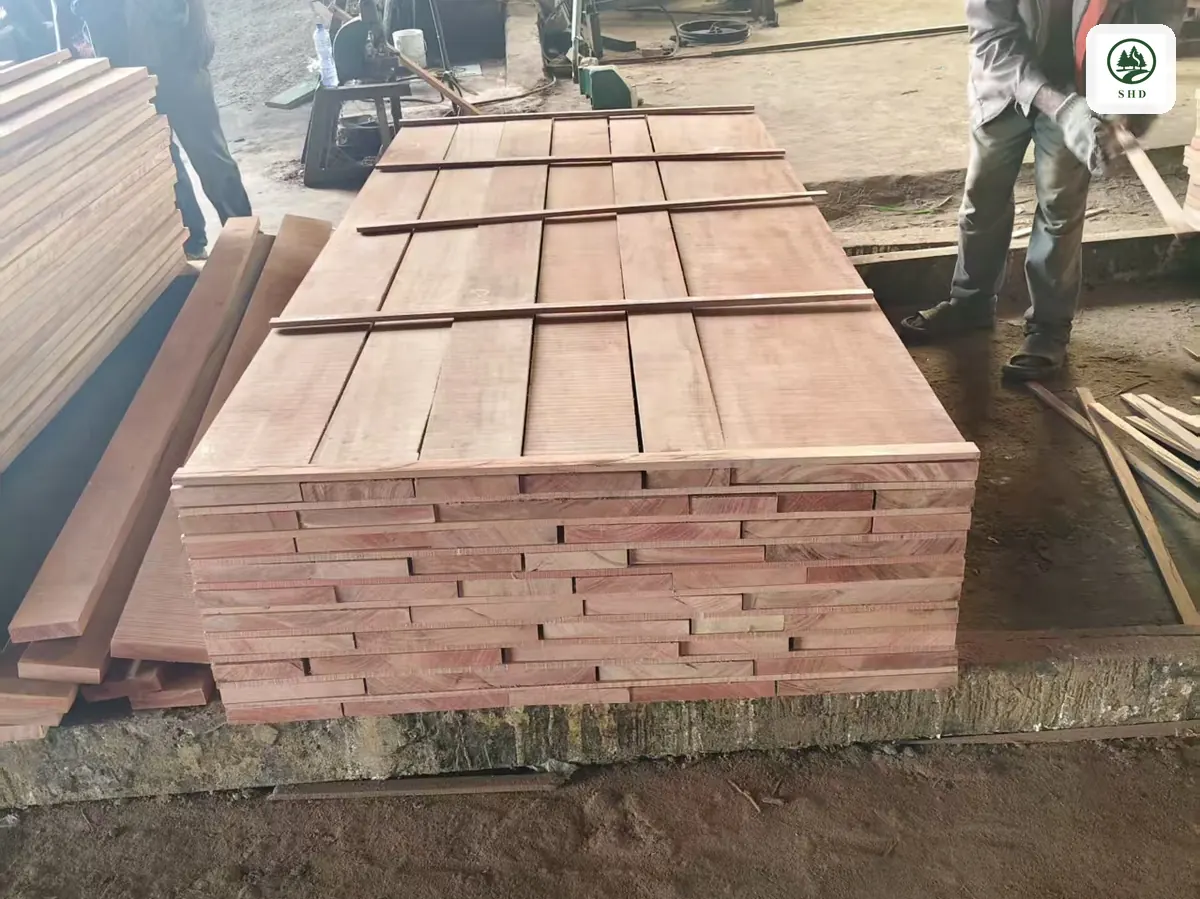
Damage is rarely the sea's fault; it's the stack's. Bundles should be banded tight, spaced with stickers where airflow matters for KD stock, and stuffed heavy-sizes-down with the packing list matching the bundle tally. Before you release the balance, ask for the loading photos and walk the packing list against them — the count, the band count, and whether the sticker pattern survives the last meter of the container. That's thirty minutes of work and the best insurance you'll buy on the order.
What a serious okoume lumber supplier confirms in writing
Watch how a seller handles five confirmations. First, your specs echoed back — thickness and tolerance, width range, lengths, grade trim rules, target moisture. Second, the document set: Commercial Invoice, Packing List, Bill of Lading, Certificate of Origin, Phytosanitary Certificate, and CITES paperwork where the species or destination calls for it (we arrange per species and destination; check your import rules while you're at it, because listing requirements change). CITES' own appendix notes make the scope plain: a listing covers the whole tree, parts and derivatives included — no permit, no clearance, no matter how nice the lumber is. Third, production, inspection and loading photos or video. Fourth, lead time stated with its conditions, not a bare number: stock moves as soon as payment and booking are set, regular production runs about 1 to 2 months, and that band doesn't cover every order — rains, inland roads, port congestion and shipping windows all bite. Fifth, honesty about limits. Ours, stated straight: we don't currently support third-party pre-shipment inspection, and we don't mail physical samples as routine — real stock photos, detail shots, production and loading video plus the packing list do the job instead. A supplier who says no upfront is still telling you the truth for free. Use that.
The commercial fine print, spelled out
Here's how a real lumber order is shaped, with nothing polished for the brochure:
- MOQ: one container for regular lumber; trial orders that meet the minimum loading quantity are welcome. Mixed sizes can often be arranged; mixed species get evaluated case by case.
- Terms: FOB or CFR/CNF quoted to your discharge port — CIF is not offered, and we don't deliver to your door.
- Payment: T/T 30% advance, 70% against copies of the Bill of Lading. Sight L/C accepted; usance L/C assessed case by case.
- Quote validity: tied to stock, production cost and freight on the day — a number from last month is a memory, not an offer.
Want the species side — density around 440 kg/m³ at KD, silica in the grain, honest durability limits? That's covered in our okoume wood guide. Live sizes and real stock photos by thickness sit on the okoume lumber page, and if you're weighing log or cant economics instead, see okoume logs. Or send your discharge port and spec sheet through the quote form — we'll answer the tolerance and moisture questions first, before anyone talks price.
Questions
Asked before every first order
What should I lock down before comparing two okoume lumber quotes?
Is kiln-dried okoume lumber always drier than air-dried?
Can you send samples before we commit?
What are the minimum order and payment terms for lumber?
Sources checked for this note
- AHEC — Grading sawn lumber: The Grades (NHLA rules explained)
- USDA Forest Service, Wood Handbook GTR-190, Chapter 4: Moisture relations and physical properties of wood (Glass & Zelinka)
- CITES — Appendices I, II and III (official site, interpretation rules)
Written by the Senheda okoume desk. Species and document rules move — verify current CITES status and your port's import requirements with your own authorities before contract.
Ready for numbers on this?
Send spec, quantity and your port — reply within 24 hours (Mon–Sat).