
Importing Okoume Logs from Gabon and Congo: A Practical Brief
A working brief on importing okoume logs from Gabon and Congo: spec-on-order sizing, the export document pack, FOB and CFR terms, MOQ, and lead time.
Before you commit freight money to okoume logs out of Central Africa, get the mechanics straight: who cuts the wood, what "spec on order" actually means, which documents travel with the shipment, and where first-time deals usually stall. Here's the Gabon and Congo channel as we run it — no port folklore, no invented fee schedules.
This is a working brief for first-time log buyers and importers switching suppliers mid-contract. We're HONG KONG SENHEDA WOOD LIMITED, a Shenzhen-based trading desk with sawmills we invested in and partner bases in Gabon and Congo, 100+ people on staff and around sixty partner factories on the processing side. What follows is what we actually do, in the order you'll need it.
Where the roundwood comes from
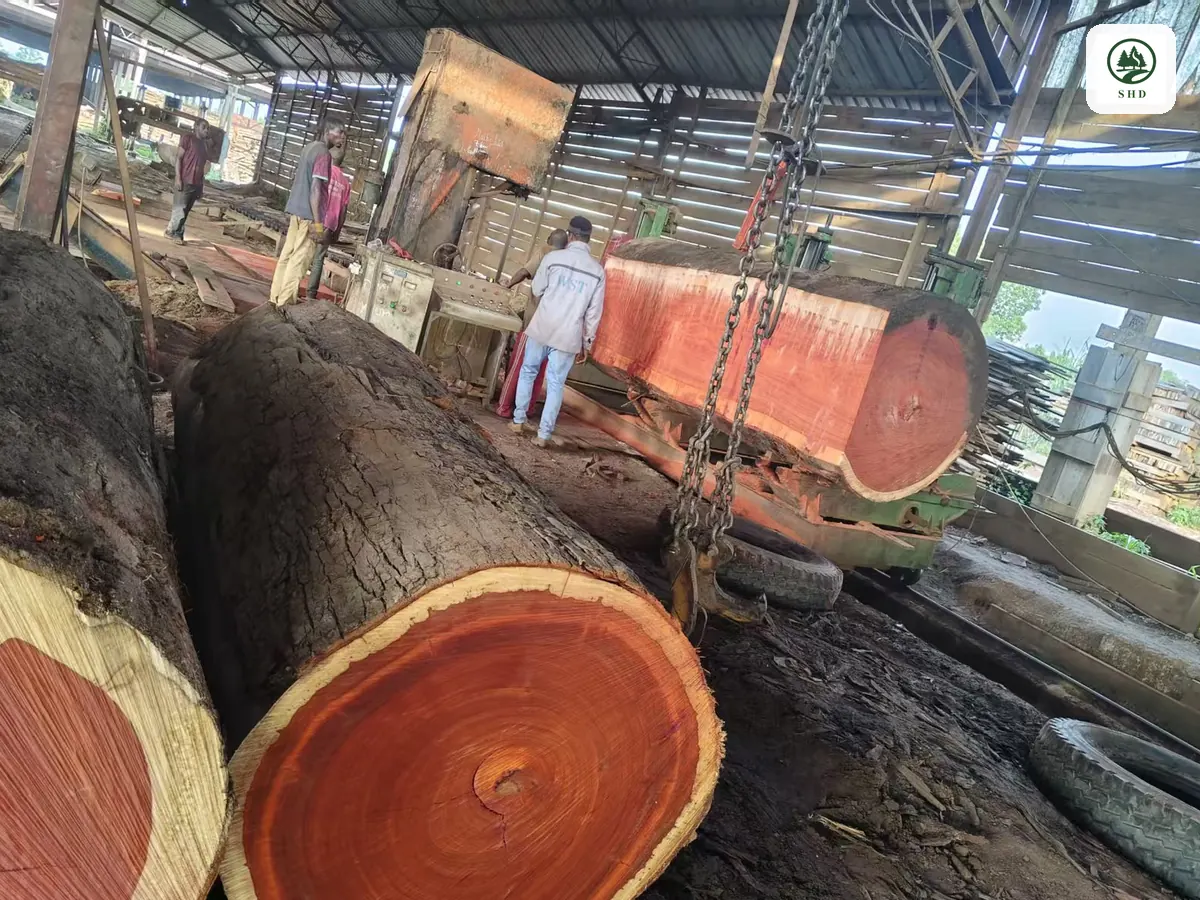
Okoume — Aucoumea klaineana — is a Central African species, and the commercial heart of its range is Gabon; The Wood Database records the distribution as "Central Africa (primarily Gabon)." The tree does well in the coastal forests of the region, which is exactly why our two origins are Gabon and Congo. We buy through our invested sawmills and partner networks there — three sawmills of our own, sixty-plus partner sawmills across the trade — the same channels that feed our lumber lines, with legal-harvest and traceability papers arranged per origin and destination. Behind all this sits 17 years in African timber, running since 2009, roughly 1,600 containers a year, and twenty destination countries. Species-side basics — density, color, the silica that dulls your blades — live in our okoume guide; this page stays on trade flow.
What "spec on order" really means for logs
Roundwood is grown, not machined. Diameter and length follow the stand, the season and the mill — not a catalog. So we confirm diameters, lengths and debarking requirements order by order, and we don't publish a fixed diameter chart, because honest roundwood numbers move from run to run. The workflow looks like this: you send target spec, volume and discharge port; we come back with what the current runs actually carry, with photos of the real logs before you commit. A seller who quotes fixed diameters before knowing your port and volume is handing you a brochure, not a spec. The ordering facts that don't move — origin, form, terms, document set — sit in the table on our okoume logs page.
The paperwork pack, line by line
Every shipment we arrange travels with a defined document set: Commercial Invoice, Packing List, Bill of Lading, Certificate of Origin, Phytosanitary Certificate — plus CITES paperwork, which is arranged by species and destination. "Arranged by species and destination" isn't hedging; it's how export control works. Listings for timber species shift with conference decisions and national annotations, so don't let anyone price a permit into your landed cost from memory. Before you sign, check the current CITES status of Aucoumea klaineana with your own management authority and your customs broker — on our side, the export permits follow whatever the rules of the origin country and your port require. If you're importing into Europe, expect real scrutiny: a European Commission guidance notice asks member states to act whenever doubts arise over the legality of timber from CITES-listed species entering the EU (Commission notice, Official Journal C 376, 2018). Paper isn't theater in this trade — it's your clearance. We confirm the full document list for your port before we quote, and we don't promise papers we can't issue.
Freight terms, payment, minimum volume
We quote FOB or CFR/CNF to your discharge port. CIF is not offered, and we don't deliver to your door — import-side clearance, insurance and the inland haul are yours to manage once risk passes at the point your incoterm defines. Payment runs on T/T: 30% deposit, 70% against a copy of the Bill of Lading. At-sight letters of credit are accepted; deferred terms get evaluated case by case. Volume is where log buyers get surprised. Our regular lumber ships from a single container, but logs and cants are heavier arithmetic — the MOQ depends on species, production arrangement and shipping, and some log orders run from five containers. Trial orders are welcome as long as they meet the minimum load. We'd rather prove a run on a small volume than fake a discount. The same ordering logic applies to okoume cants: sized to order, quoted against live stock.
Why buyers start with roundwood instead of lumber
Buying logs is a margin decision, not a preference. If you own a sawline or a peeler, roundwood keeps the processing spread inside your own factory gates instead of paying a supplier for it. Picture a small veneer lathe somewhere on the Mediterranean coast: a five-container trial of Gabon okoume logs, graded from loading photos, peeled into faces for panel plants — the yield math only works because the factory, not the exporter, owns the conversion step. The trade-off is honest too. As a log buyer you carry the grading risk, the shrink-out and the yield variance that a lumber buyer pushes onto the seller. If you don't own the line yet, start with okoume lumber and switch to roundwood once your economics justify it. That's the arithmetic behind most moves to a direct log account — quality consistency across containers matters more than any promised diameter you'll never average.
Lead time: plan around rain, roads and vessel windows
Stock lots move fast once payment terms and booking are confirmed. Regular production orders often take around one to two months — and that figure does not cover every order, no matter what a competitor's website promises. Rain seasons slow extraction and road movement. Port congestion reshuffles sailing dates. Vessel windows come and go. Documentation itself takes time whenever phytosanitary or CITES review is in play. Budget for that reality, then ask us for the order-specific estimate before you commit to your customer. Through production we send photos and video of the goods and of container loading, so the 70% balance lands against evidence, not hope; on-site inspection before shipment is also possible. Third-party inspection services, though, are not something we support today.
Ready to price a run? Send your destination port, target log spec and monthly volume through our inquiry form — you'll get stock or production lead time, the document list for your port, and an FOB or CFR number you can actually build a landed cost on.
Questions
Asked before every first order
Which documents come with a shipment of okoume logs?
Do you publish a fixed diameter or length chart for okoume roundwood?
What's the minimum order, and can a first-time buyer test with a small volume?
How long does an okoume log order take from deposit to departure?
Sources checked for this note
- Okoume (Aucoumea klaineana) — The Wood Database
- Commission notice — Guidance document on steps to be taken by EU Member States in the case of doubts as to the legality of timber from CITES-listed species imported into the EU (OJ C 376, 18.10.2018)
Written by the Senheda okoume desk. Species and document rules move — verify current CITES status and your port's import requirements with your own authorities before contract.
Ready for numbers on this?
Send spec, quantity and your port — reply within 24 hours (Mon–Sat).